The Velvet Gang's Space Shuttle
I Love Boosters, dir. Boots Riley, 2026
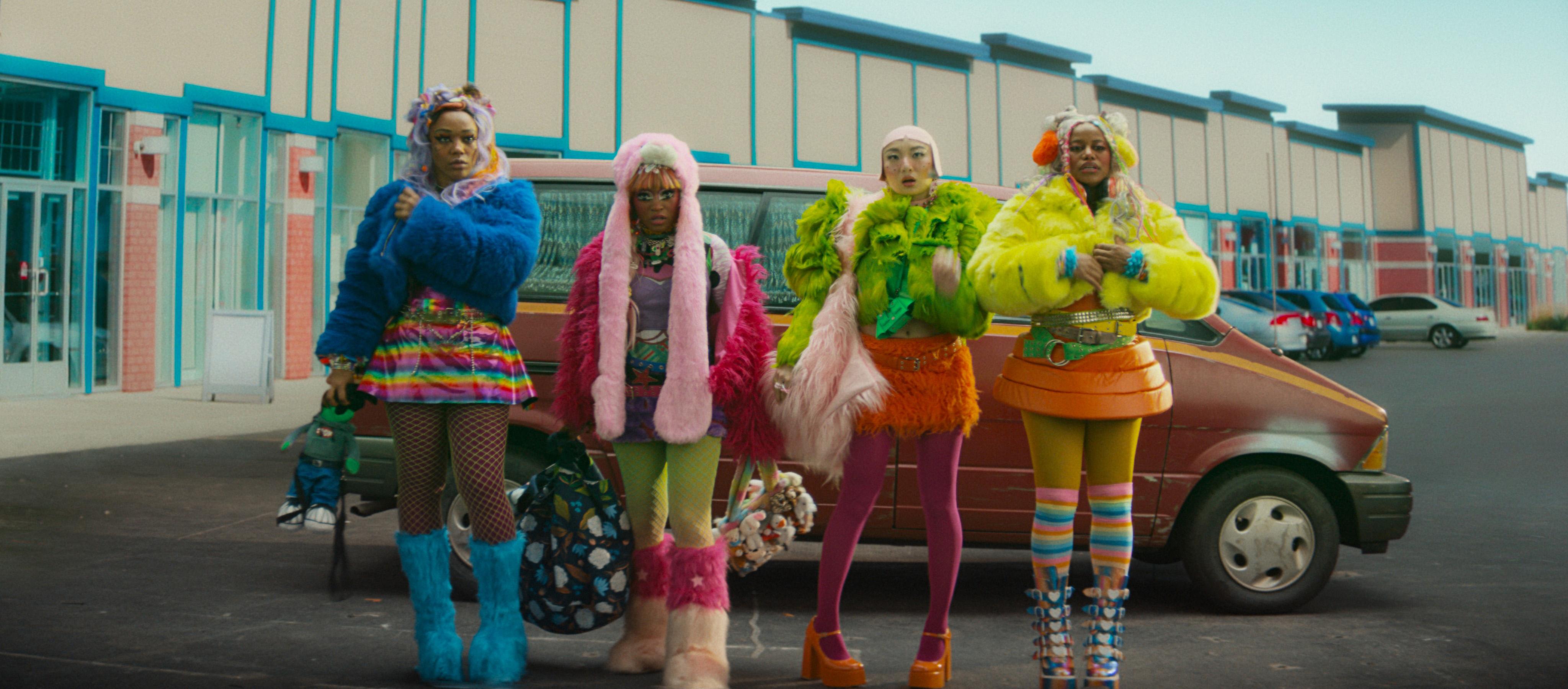
In I Love Boosters, the Velvet Gang are artists, organizers, and shoplifters. They operate out of a former chicken restaurant in the Bay Area, dressed in colourful platform boots and faux fur. Director Boots Riley presents this as cohesion rather than contrast. He’s interested in such synthesis as a way of being—as an activity, not as an outcome. The Velvet Gang, like Riley himself, apply their creativity toward the unlikely synthesis of seemingly disparate pieces, before the world gets hold of it and decides what it means.
Courtesy of Neon
The Velvet Gang’s vehicle is a Ford Aerostar. With a trailer hitch. It’s an understated counterweight to the Gang’s extreme style. But it also has a distinct character of its own.
The Aerostar was part of the first generation of minivans, which combined the flexibility and spaciousness of commercial vans with amenities of the family station wagon. The era was kicked off when Chrysler announced the Caravan in 1983, taking everyone by surprise by building something that felt more like a car than a converted work vehicle. It was softer, more domestic, with front-wheel drive and wood-grain paneling. Ford was already committed to a different answer: rear-wheel drive, truck-derived platform, rated to tow more than twice the Caravan’s capacity, and was even eventually offered with a manual transmission and four-wheel-drive.
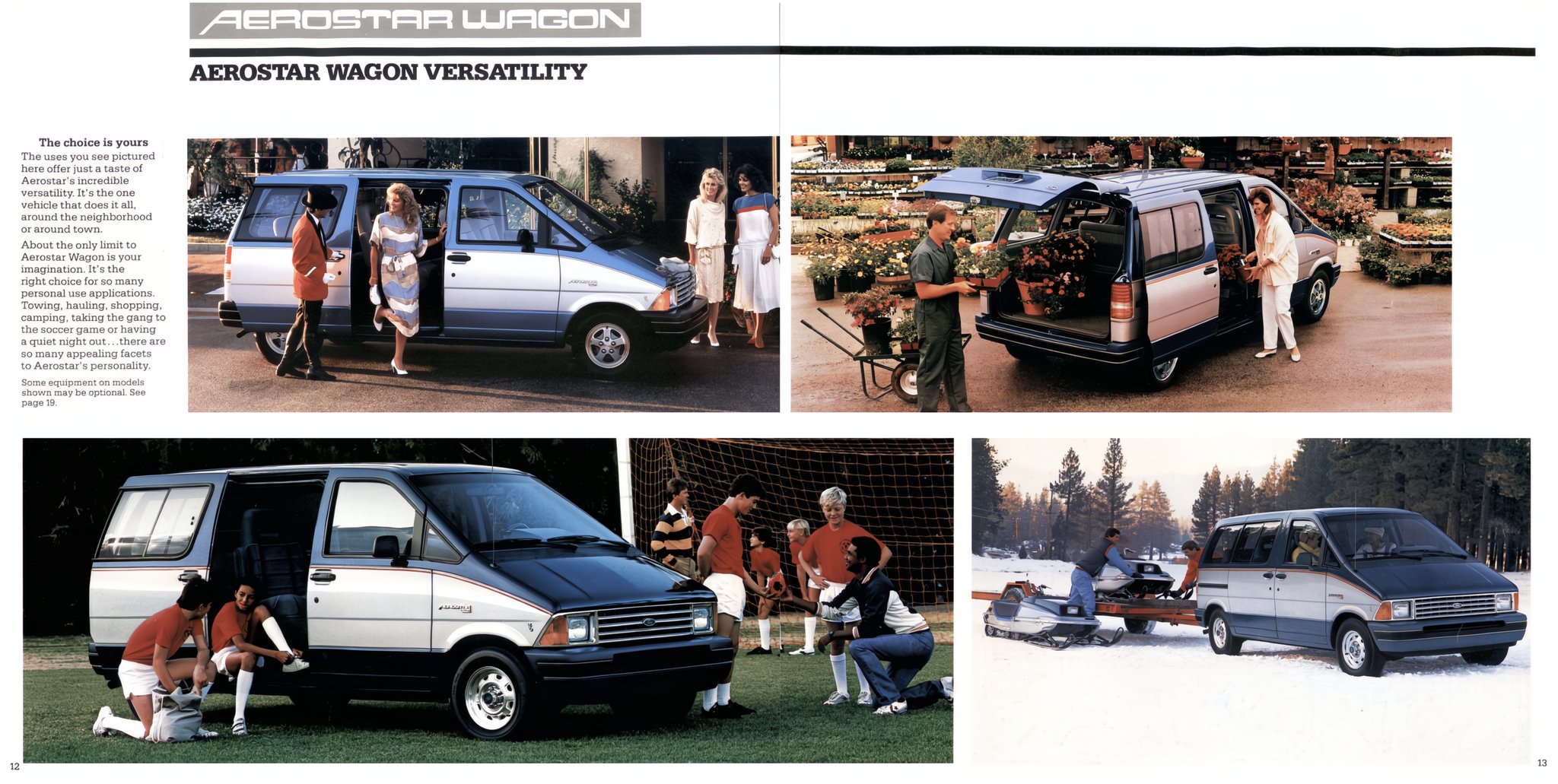
1986 Ford Aerostar Wagon brochure. Courtesy of oldcarbrochures.org
The choice isn’t obvious—even other vans of the same era wouldn’t fit the role. A Vanagon reads as counterculture. A Previa or a Trans Sport reads as eccentricity. A Caravan reads as domesticity. An Astro reads as serious. The Aerostar reads as none of these things. It’s the form before it decided what it was. That stage of pre-understanding is what Riley is interested in.
In the 1980s, American cars were at their most pared back. The gas crisis of the 70s forced them to become smaller and more streamlined, in direct contrast to the flourishes that characterized previous decades. Ford’s design chief had spent the 70s running Ford of Europe and working with the Ghia design studio in Turin. The Aerostar was part of what he brought back: a position about what an American vehicle could look like. Ford compared its profile to a NASA Space Shuttle: a wedge shape, a sloped nose, a drag coefficient matching that of their luxury coupe. Its look may appear simple today, but it was designed with intention, from a distinct point-of-view, at a particular inflection point for the industry.
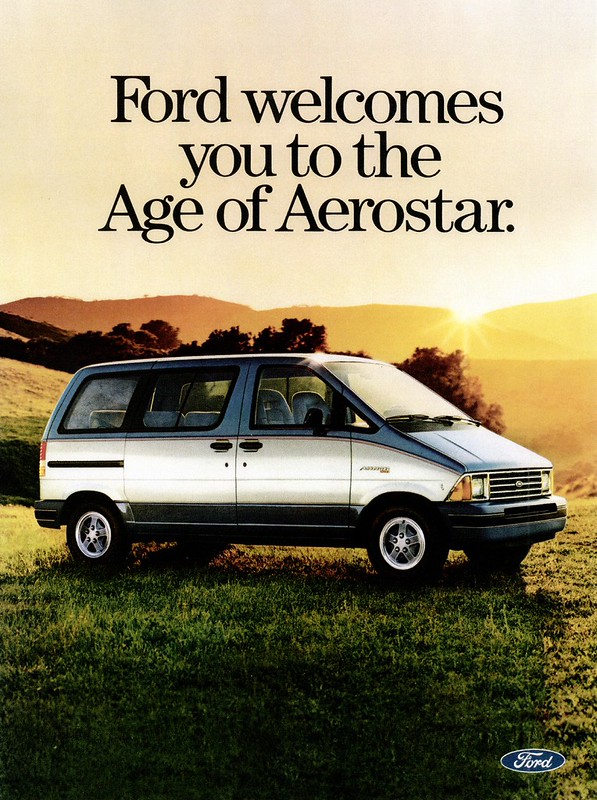
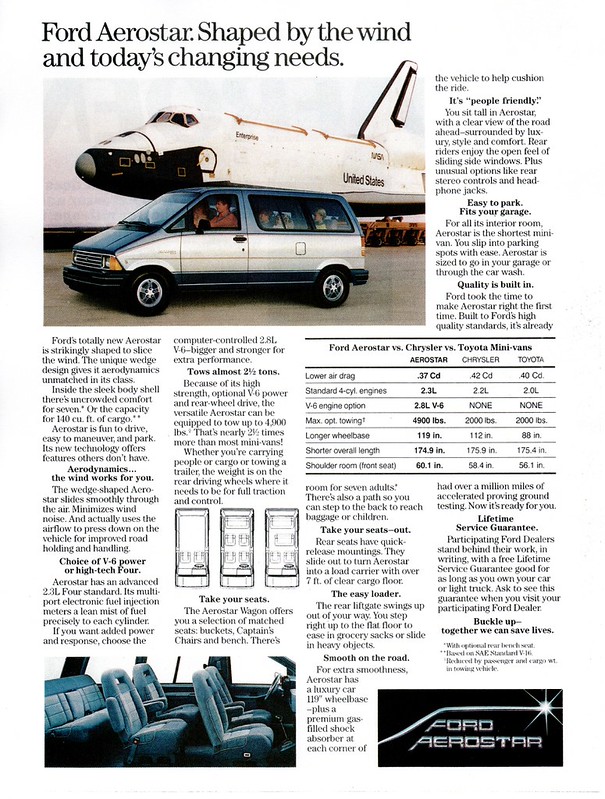
“1986 Ford Aerostar (USA) p1” and “1986 Ford Aerostar (USA) p2” by Michael, CC BY-NC-SA 2.0
As a result of this awkward stage of adjustment, the Aerostar has something slightly off about it: the characterizing fascia and body lines pushed to the extremities of a form optimized for internal volume, like a face drawn on an inflating balloon. It wasn’t as commercially successful as Chrysler’s Caravan, and even Ford left the Aerostar name behind after a single generation, renaming their next generation the Windstar while the Caravan name has survived to this day. Still, the Aerostar’s truck-based logic was a distinct take, and one the market eventually returned to in the SUV era.
The Aerostar fits I Love Boosters because it matches the approach of the Velvet Gang and the film itself: an honest expression of style and capacity. Neither one is a performance of the other. They both know exactly what they are, and neither needs the other to confirm it. They are impressive for what they achieve from first principles, responding to upheaval from bare instinct, and arriving at something uniquely appropriate if not optimal. You feel that alignment before you can explain it.
The Velvet Gang dress maximally but are, underneath that, workers with a practice and a code. They operate with the efficiency of friends who have been working together for years. The Aerostar fits not because it’s coordinated with their outfits—the Velvet Gang haven’t applied their signature aesthetic to their vehicle. Customization, if you can call it that, seems to have been limited to the practical addition of privacy curtains, a tow hitch, and some non-matching touch-up paint.
There’s a window—between a form becoming available and a form becoming an icon—where the connection between feeling and understanding is especially alive. That’s where Riley is at home: the moment before something is named, before the creative is completely absorbed into the commercial. Both the Aerostar and the Velvet Gang are there too: present before the form is decided, specific before the world names them. That’s what makes the casting exact.
Get new pieces by email.